
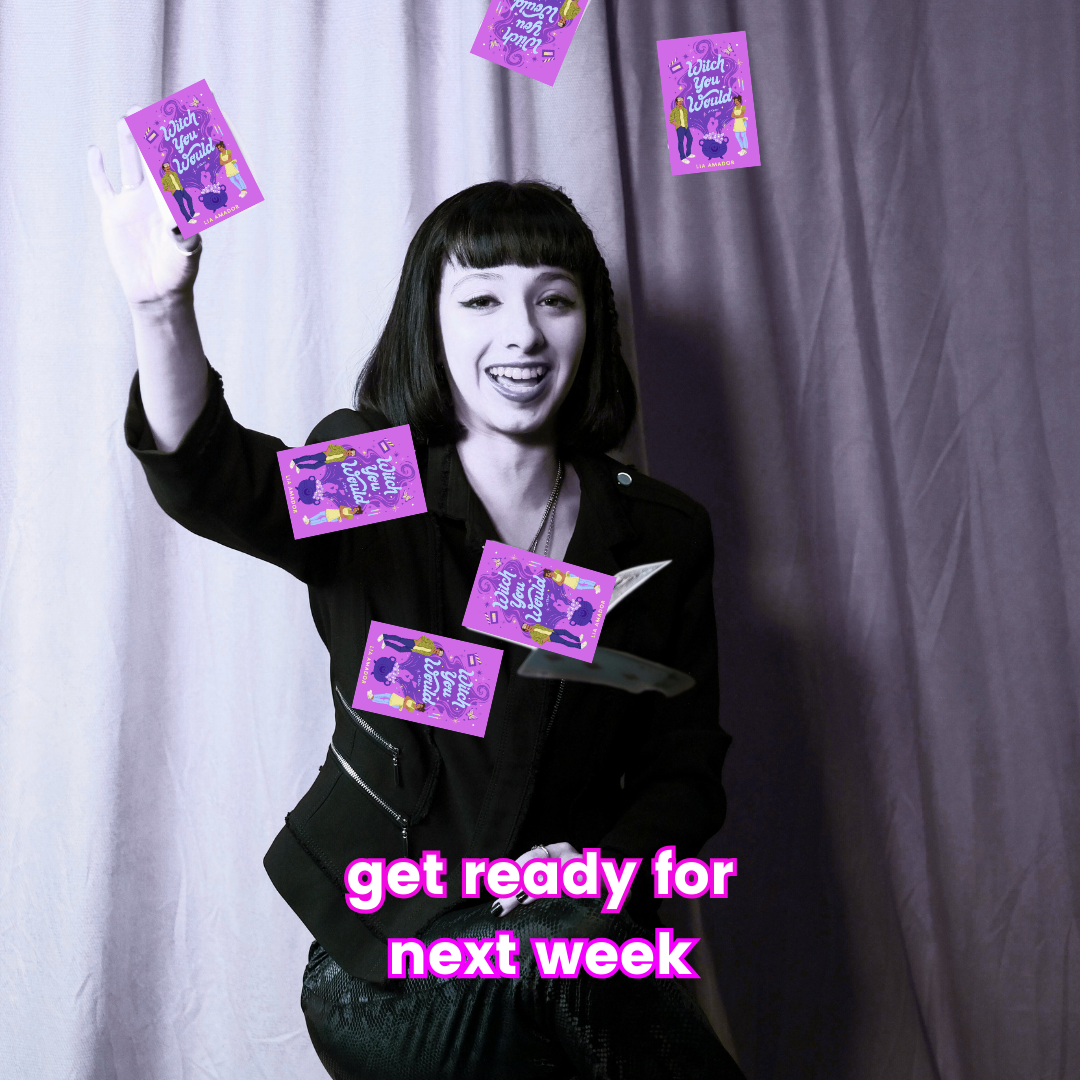
Time flies, much like a cartoon Elizabeth Montgomery on her broomstick. It’s been a million years since Witch You Would was announced, but now merely a single week remains until it comes out. To celebrate the release, join me on my Twitch channel on September 2nd at 9pm ET as I read from the book, answer questions, and have a secret surprise giveaway.
I’ve talked a bit about how this book started and how it evolved, and how the cover came together. What I haven’t talked about as much is the ways this book strikes a few personal chords for me.
Even when writers are writing about characters who are very different from ourselves, there are often still some core elements that, intentionally or subconsciously, reflect parts of us. We may not be holding up a full-length mirror, but we may be peering into a warped funhouse glass that exaggerates some qualities and minimizes others. We may be crafting silhouette portraits, or caricatures, or the darkest timeline versions of ourselves. We may even be Frankensteining parts together to create new wholes.
The two main characters in Witch You Would reflect a lot of my anxieties, and the ones I see in people around me. The fear of failure, of screwing up and not being able to fix it. The fear of being authentically yourself, only to be rejected because of who you are or aren’t. The fear of being stuck in the same dead-end grind with no way to improve your life. These are people who want to do more and be more, become better versions of themselves, and they’ve worked and lucked into having that chance—but it’s still not guaranteed, and that scares them.
So many people today don’t have the same opportunities, and are just getting by as best they can. We take risks, we hustle, we’re told we can do anything and be anything, and then reality kicks our asses. It’s a very millennial experience, I think, and one that younger generations are growing up in, maybe not realizing things weren’t always like this. And they don’t have to be, but there’s only so much we can individually do. We still keep trying, though, and passing around the hat with the same twenty bucks inside.
People who know me and my husband may also notice some shared elements in the romance and the vibe between the characters. I’m the overthinker who makes lists and nerds out about random stuff, my husband is the goofy performer always ready to drop a bad pun… and vice versa, to a certain extent. When high school superlatives were handed out, we were both voted Funniest; we’ve both made each other do a spit take, more than once. His task lists can get longer than mine, and he’s been known to go on deep research dives when buying a product the same way I do when I’m trying to get some tiny detail right in a book. But in the end, we’re a team. He’s definitely the one with the outrageous mustache, though.
Penelope and Gil both also feel responsible for continuing the legacy of their grandparents, in their own ways. The story of Penelope’s family in particular, especially who her abuela was and what she was like, is drawn from my own family history. My abuela lied about her age to get an education, worked her way through nursing school, and kept working even after she married a doctor and could have become a housewife instead. She supported our family when they emigrated from Cuba, and was a school nurse until she retired.
I have so many good memories of sitting in the kitchen, listening to her sing off-key while she cooked, learning how to make rice and beans or packing Cuban coffee into the cafetera. Watching her stick toothpicks through avocado seeds and coaxing them into sprouting on the windowsill. Like Penelope, I still have one of her cookbooks. Losing her to dementia was a long, slow journey that hurts to remember because of how vibrant she always was, and how she shrank into herself, that color and joy seeping away and fading. Writing a version of her into this book lets me remember the happy times, the bright times, as well as the sadder ones.
I could say more—about friendships, and siblings, and film people, and cafecitos, about kitchen fires and botanical gardens and the “real” Miami in all its myriad forms—but I should probably leave some things for you to discover when you read the book. You won’t have to wait much longer!